


· By Steven Wong
Do Dogs Really Smile? What Canine Facial-Expression Research Says
Published August 2026 · Pet N Pet Editorial · National Dog Day Science Series
Sort of, but not in the way most people think. In 2019, researchers found dogs uniformly evolved a facial muscle, the levator anguli oculi medialis, that lets them raise their inner eyebrows into the classic "puppy dog eyes" look, a muscle wolves largely lack (Kaminski, Waller, Diogo, Hartstone-Rose, and Burrows, PNAS, 2019). A separate 2017 study found dogs use that exact expression significantly more often when a human is actually paying attention to them, not just when food is present (Kaminski, Hynds, Morris, and Waller, Scientific Reports, 2017).
But the one study that directly compared dog and human facial expressions side by side, muscle by muscle, came to a blunt conclusion: dogs do not display human-like facial expressions (Caeiro, Guo, and Mills, Scientific Reports, 2017). Here's what the research actually supports, and where the "dogs smile just like we do" claim overreaches.
The Muscle Behind 'Puppy Dog Eyes'
In 2019, a team of researchers dissected the facial muscles of dogs and wolves and found dogs uniformly have a well-developed levator anguli oculi medialis, the muscle that raises the inner corner of the eyebrow. In wolves, the same spot showed only "a scant, irregular cluster of fibers" (Kaminski, Waller, Diogo, Hartstone-Rose, and Burrows, PNAS, June 2019). The only dog breed in the study without a fully developed version was the Siberian husky.
When exposed to a human for two minutes, dogs raised their inner eyebrows more often, and at higher intensity, than wolves did, and the very highest-intensity movements came exclusively from dogs (Kaminski et al., PNAS, 2019). It's one of the clearest anatomical signs that this specific expression evolved alongside living with people.
Dogs Make the Expression More When You're Actually Watching
A 2017 experiment tested 24 dogs across four conditions: an attentive human with or without food present, and an inattentive human with or without food present. The inner-eyebrow raise showed the single strongest effect of any facial movement measured, with a massive statistical effect (p<0.0001) tied to whether the human was paying attention (Kaminski, Hynds, Morris, and Waller, Scientific Reports, October 2017). Food alone had no measurable effect on the dog's expression at all (p=0.74).
As lead researcher Juliane Kaminski of the University of Portsmouth put it in the study's press materials, "we can now be confident that the production of facial expressions made by dogs are dependent on the attention state of their audience and are not just a result of dogs being excited." That's a meaningful distinction. The expression looks emotional, but the timing looks communicative.
So Is It Actually the Same as a Human Smile?
This is where the honest answer gets more complicated. Researchers built a tool called DogFACS, modeled directly on the human Facial Action Coding System, specifically so they could measure dog facial movements without assuming what those movements mean emotionally (Waller, Caeiro, Peirce, Burrows, and Kaminski, PLoS ONE, 2013).
Using that same rigorous coding on both species, one study directly compared 100 dogs and 50 humans across matched emotional contexts, including happiness. The result: dogs' happy expressions were dominated by mouth and tongue movement, while humans' were dominated by the eye region, two structurally different signals. The study's own conclusion states plainly that dogs do not display human-like facial expressions (Caeiro, Guo, and Mills, Scientific Reports, November 2017).
The Same Mouth Shape Can Mean Two Very Different Things
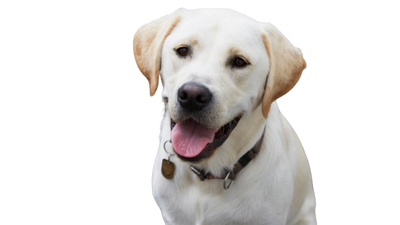
A relaxed, open-mouth "play face," loose jaw, tongue out, no tension around the eyes, is widely understood in ethology as a genuine signal of relaxed, positive arousal during play. But a similar-looking lip-back, teeth-showing expression can also be a submission or appeasement display, a signal that traces back to foundational research on wolf and dog submission behavior (Schenkel, American Zoologist, 1967).
The mouth shape alone doesn't tell you which one you're looking at. Context does. A relaxed body during play versus a lowered posture and averted gaze during a tense interaction point to two very different messages behind what can look like the same "smile."
One More Wrinkle: Some Dog Faces Are Just Harder to Read
A May 2026 study using eye-tracking on 44 participants found people needed 42% more visual visits, 46% more eye movements, and 45% more total gaze time to read the facial expressions of a flat-faced (brachycephalic) breed like a Boston terrier compared with a longer-nosed breed like a Jack Russell terrier (Sheidin et al., Frontiers in Veterinary Science, 2026). Reading a dog's expression accurately depends partly on the shape of the face doing the expressing.
Frequently Asked Questions
Can dogs actually smile?
Not in the same structural way humans do. Dogs evolved a muscle that lets them raise their inner eyebrows, and they use it more when a human is paying attention, but a 2017 study that directly compared dog and human facial expressions found dogs' happy expressions are mouth-and-tongue driven rather than eye-driven like a human smile, concluding dogs do not display human-like facial expressions.
Do dogs make facial expressions on purpose for humans?
The strongest evidence points that direction. A 2017 study found dogs raised their inner eyebrows significantly more when a human was actively paying attention to them, with food alone having no effect at all. That timing suggests at least some dog facial movements function as communication, not just an automatic emotional reflex.
What's the difference between a happy dog face and a submissive grin?
Both can involve a similar open-mouth, teeth-showing shape, but they mean very different things. A relaxed 'play face' with a loose body signals positive arousal, while a submission or appeasement grin, often paired with a lowered posture, signals deference rather than happiness. Body language and context, not the mouth shape alone, tell you which one you're seeing.
Is it true some dog faces are harder to read than others?
Yes. A 2026 eye-tracking study found people needed roughly 42 to 46% more visual effort to read the facial expressions of flat-faced breeds compared with longer-nosed breeds, suggesting face shape itself affects how clearly a dog can communicate.
What muscle lets dogs make 'puppy dog eyes'?
The levator anguli oculi medialis, a muscle that raises the inner corner of the eyebrow. A 2019 study found dogs consistently have a well-developed version of this muscle, while wolves have only a vestigial, underdeveloped version of the same structure.
Bottom Line
Dogs really do make an expression that looks like a smile, and there's solid evidence they deploy it more when a person is watching, which points to something communicative rather than purely emotional. But the one study built to compare it directly against an actual human smile found the two aren't built the same way. Call it a real, evolved, largely honest expression. Just not quite a smile in the way we mean it.
d